
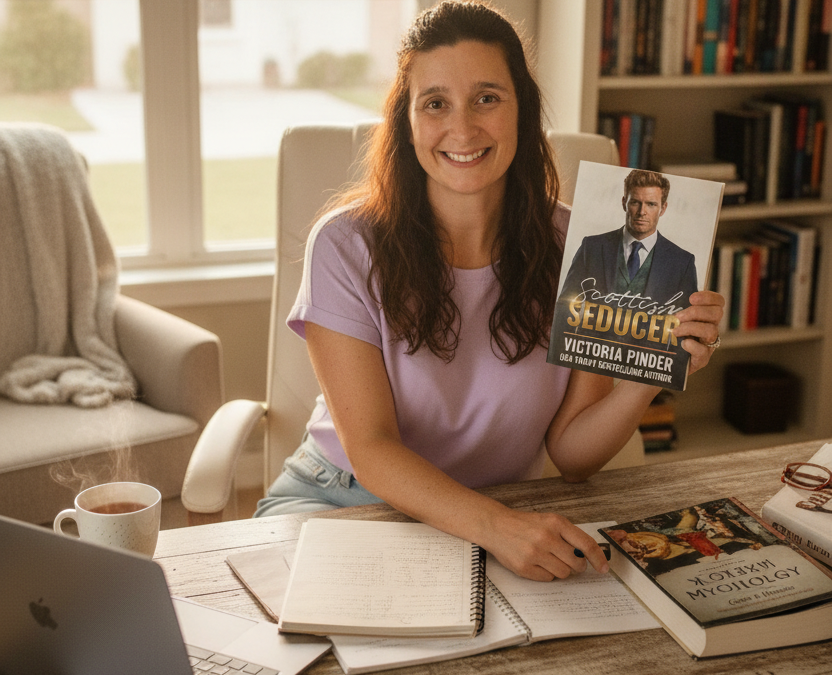
Why I Write Mythology Romance (And Always Will)
If you have ever picked up a romance novel and felt something beneath the surface — something older than the plot, older than the couple, older than anything you could name — you already understand mythology romance. I am USA Today Bestselling Author Victoria Pinder, and mythology has shaped my writing from the very beginning. Every series I have ever written carries some thread of it, but nowhere more explicitly than in the Tempting Series, where ancient power hides inside very modern, very dangerous love stories. In this essay I want to take you behind the scenes of how mythology actually functions in my books — not as decoration, but as the engine of everything.

What Is Mythology Romance, Really?
Mythology romance is not just retelling a specific myth with new names. The best mythology romance — the kind that stays with you — uses mythological structure and mythological stakes inside a story that feels completely modern and real. The gods do not have to appear on the page. The divine intervention does not have to be literal. What has to be present is the weight of fate, the sense that two specific people were arranged to collide by something larger than either of them, and the price that must be paid for love that defies the expected order.
Think about what mythology actually is at its core. It is the story of beings — human or divine — who want things they are not supposed to have. Who love people they are not supposed to love. Who defy the order of the world and either triumph magnificently or pay a devastating price. That is every great romance novel ever written. The genre and mythology have always been the same conversation.
I have been obsessed with this since I was a teenager reading Greek mythology at the library and thinking — this is just romance with better special effects. The tragedy of Orpheus and Eurydice is a second-chance romance where he breaks the one rule he had to follow. Persephone and Hades is a forced proximity story set in the underworld. Psyche and Eros is enemies-to-lovers with literal divine interference. The bones are identical. The emotion is identical. Only the supernatural scaffolding differs.
How Mythology Victoria Pinder Began: The Honest Story
I did not sit down and say I am going to write mythology romance. It crept in. It always does.
When I started building the Hawke family for the Tempting Series, I knew I wanted five powerful men connected by something beyond business and bloodline. I knew I wanted the threat they faced to feel genuinely ancient — not a corporate villain with a motive you can diagram on a whiteboard, but something with roots that go deeper than any of the characters can fully trace. And I kept coming back to mythology. To the idea of a family that carries divine weight without knowing the source of it. Power that is inherited not just through wealth and influence but through something the modern world does not have a word for anymore.
Conner Hawke became the future King of Montina — but the kingdom is almost secondary to what he carries internally. There is a gravity to him. A pull. Olivia feels it from the first moment she is in the same room with him and she does not trust it because she is sharp and self-aware enough to know that that kind of pull is usually a warning sign. She is not wrong to be suspicious. She is also not going to be able to outrun what the universe arranged.
That tension — between a woman’s rational resistance and a force that is genuinely mythological in scale — is what mythology romance does better than any other subgenre. It gives the emotional stakes a cosmic justification without ever asking you to fully suspend disbelief.
The Mythology in the Tempting Series — What You Might Have Missed
If you have read the Tempting Series, you already know that the surface story is romantic suspense: fake engagements, ex-Marine bodyguards, royal politics, heiresses in real danger. What you might not have consciously noticed is the mythology architecture underneath all of it.
The Hawke Family as a Divine Lineage
Every member of the Hawke family carries a specific quality that functions almost like a divine attribute in the classical sense. Conner carries authority — not just the authority of wealth and title but something older, the kind of presence that makes rooms go quiet. James Clancy (Scarlett’s story) carries the protector instinct at a level that goes beyond training or choice. It is constitutive. He cannot turn it off. He was built for it in a way that feels, if you are paying attention, almost ordained.
In Greek mythology, divine qualities are inherited and inescapable. Achilles cannot choose not to be the greatest warrior — it is what he is. Cassandra cannot choose not to see the future — the gift and the curse came together. The Hawke men carry their attributes the same way. Not as superpowers. As inescapable character. And the women who love them are inescapably drawn into the orbit of those qualities — which is both a gift and a genuine threat to their safety and autonomy.
The One Deadly Threat as a Mythological Trial
Every mythology worth its name features a trial that tests whether the hero is genuinely worthy of what they love. Hercules had twelve labors. Perseus had to behead Medusa to earn Andromeda. The Hawke men face one deadly threat that connects all five books — a threat that is not random but specifically designed to test whether each man is truly what his lineage claims he is.
I planned this intentionally. I wanted the threat to function the way mythological trials function: not as an obstacle to the romance but as the mechanism by which the romance is proven real. You do not know whether love is real until it is tested by something that could actually destroy it. That is mythology. That is also the best romantic suspense.
Why Mythology Romance Hits Differently Than Other Subgenres
I want to be honest with you about why I keep returning to mythological structures even when I am writing contemporary romance, military romance, royal romance, or billionaire romance. It is not because mythology is trendy — it has always been present in the genre, it just surfaces more visibly in some eras than others. I return to it because mythology romance solves a specific emotional problem that other structures cannot solve as elegantly.
The problem is this: modern romance readers are sophisticated. We have read thousands of books. We know the tropes. We know the beats. We know that the couple is going to end up together. The question is never if — it is why. What makes this specific love story feel inevitable in a way that does not feel lazy or predictable?
Mythology provides the answer. When mythological structure is working correctly inside a romance, the couple’s connection does not feel like a coincidence or a contrivance. It feels fated — not in a passive, they-had-no-choice way, but in the active, hard-fought, universe-had-a-plan-and-they-chose-to-honor-it way. That distinction matters enormously. The best mythology romance does not rob characters of agency. It gives their choices cosmic weight.
Olivia choosing to stay with Conner when she could leave — that choice lands differently because the reader understands that something larger than convenience or attraction arranged them. Her choosing to honor that is active heroism. Same for Scarlett choosing James when every rational instinct says run. The mythology framework makes those choices feel like the most important choices in the world. Because inside that story, they are.
Mythology Romance vs. Paranormal Romance: The Real Difference
| Feature | Mythology Romance | Paranormal Romance |
|---|---|---|
| Supernatural elements | Felt, rarely shown explicitly | Shown explicitly (magic, shifting, fangs) |
| Setting | Fully modern (palaces, boardrooms, cities) | Often parallel world or historical |
| Stakes | Both personal and cosmic | Often world-ending or clan-based |
| Reader suspension of disbelief | Low — story stays grounded in realism | High — full world-building required |
| Emotional core | Fated love tested by mortal choice | Love tested by supernatural threat |
| Classic examples | Psyche and Eros retellings, hero-legacy stories | Vampires, shifters, fae, dragons |
The reason mythology romance reaches readers who do not normally read paranormal is exactly that low suspension-of-disbelief requirement. You do not have to believe in gods to feel the pull of a fated connection. You just have to believe in the feeling. And everyone who has ever fallen in love understands the feeling that this was always going to happen.
Other Series Where Mythology Lives Quietly
The Tempting Series is the most explicit mythology romance I have written, but it is far from the only one. If you explore my full catalog at victoriapinder.com/romance-book-series/ you will find mythological structure everywhere once you know what to look for.
The Princes of Avce Series
The fictional kingdom of Avce is built on mythological logic. Twelve princes, each carrying a specific kind of power, a kingdom with ancient rules about succession and legitimacy, and heroines who walk into a world with laws they do not fully understand until they are already in love. The royal romance structure and the mythology structure are cousins — both depend on a world with older rules than the modern one, rules that shape the love story from the outside in. If you have not started this series, the Princes of Avce royal romance page has the full reading order.
The Modern Scottish Lairds Series
Celtic mythology has always been the mythology I return to most in my personal reading, and it absolutely bleeds into the Scottish Lairds books. Ancient castles in the Scottish Highlands are not just a setting. They are a mythological assertion: this place has memory. This place has rules. The land itself is a character. When Miriam and Banner are snowbound together in that castle in Wrong Scot for Christmas, the isolation is not random — it is the kind of mythological confinement that forces truth. The lairds series explores Scottish Highland romance with that mythological weight built into every stone wall.
The Irresistibly Series
This one surprises people. The Brothers in Revenge saga looks like pure contemporary romantic suspense — a displaced royal family fighting to reclaim a stolen throne, counter-espionage, Safe Rooms, seven brothers. But the structure is deeply mythological. Seven brothers, a murdered king, a frozen inheritance, and a woman who was sent to destroy them and ended up being the one who saves everything. That is Psyche and Eros. That is the story of the mortal who enters the divine household as a spy and leaves as the person the household cannot survive without. Eva and Jake are one of my most mythologically resonant couples and most readers do not consciously notice it — they just feel it. Find the full series at victoriapinder.com/enemies-to-lovers-romance/.
What Mythology Romance Taught Me About Writing Love
I have published over 100 novels now. More than 100 love stories. And the one thing mythology keeps teaching me — book after book — is that love is not small. We live in a culture that sometimes treats romantic love as a distraction from real life, a nice-to-have, a comfort item. Mythology disagrees. Mythology insists that love is the most consequential force in the universe. Gods reshape the cosmos for it. Heroes walk into the underworld for it. Mortals defy the divine order for it.
Romance novels, at their best, insist on the same thing. The love story is not a subplot of a larger life. It is the story. The mythology framework simply makes that insistence explicit and gives it the narrative weight it always deserved.
When I am writing a couple — any couple, in any series — I am always asking the mythology question: what is the divine trial here? What is the thing that proves this love is real and not just convenient? What would these two people have to give up, face, or choose in order to honor what they found in each other? The answer to that question is always the heart of the book. Everything else is scaffolding.
If you love mythology romance — whether you call it that or you just know it when you feel it — I hope you will explore the Tempting Series and the rest of my catalog. There is something in every series for the reader who wants love to feel like it matters at a cosmic level. Because it does. It always has. Mythology just had the courage to say so out loud.
Start Reading: Featured Books from the Tempting Series
The Tempting Series is available on Apple Books, Amazon, Barnes and Noble, Kobo, Google Play, and all major retailers. Start with The Hawke Fortune Book 1 at victoriapinder.com/books/the-hawke-fortune-1/ — all retailer buy buttons are on that page. Explore the full romantic suspense catalog at victoriapinder.com/romantic-suspense/.
And if you want to know where mythology romance lives across my entire library — from Avce to the Scottish Highlands to Miami — visit victoriapinder.com/romance-book-series/ for the complete series guide.
DM me the word TEMPTING on Instagram and I will send you the full reading order personally. I love talking about these books. I will never get tired of it.
Frequently Asked Questions
What is mythology romance and how is it different from paranormal romance?
Mythology romance uses the structural and emotional logic of classical myths — fated love, divine trials, cosmic stakes — inside stories that feel grounded and modern. Unlike paranormal romance, which features explicit supernatural elements like vampires or magic, mythology romance keeps its divine layer beneath the surface. You feel it rather than see it. The result is high emotional stakes with low suspension-of-disbelief requirements, making it accessible to readers who do not normally read fantasy or paranormal.
Which Victoria Pinder series features the most mythology romance elements?
The Tempting Series is Victoria Pinder’s most explicitly mythology-rooted series, featuring five Hawke brothers who carry ancient power inside modern royal and billionaire settings. Fake engagements, ex-Marine protectors, and one deadly threat connecting all five books give the series a mythological trial structure. The Princes of Avce and Irresistibly Series also carry strong mythological undercurrents for readers who enjoy the subgenre.
Where should I start with Victoria Pinder’s mythology romance books?
Start with The Hawke Fortune Book 1, the opening novel of the Tempting Series, available on Apple Books, Amazon, Barnes and Noble, Kobo, Google Play, and more at victoriapinder.com/books/the-hawke-fortune-1/. If you prefer royal mythology romance, Forbidden Crown — the first Princes of Avce book — is permanently free on all retailers and a perfect entry point into Victoria’s royal romance world.
Is mythology romance appropriate for readers who do not enjoy fantasy or supernatural stories?
Yes — mythology romance is one of the most accessible subgenres for readers who prefer contemporary fiction. The stories are set in the real modern world: boardrooms, palaces, coastal towns, Miami. The mythological elements function as emotional and structural undercurrents rather than visible magic or supernatural events. If you love romance with deep emotional weight and the feeling of fate, mythology romance will work for you even if fantasy does not.
What mythology traditions does Victoria Pinder draw from in her writing?
Victoria draws most frequently from Greek mythology — the divine trials, fated pairings, and mortal-versus-divine-order conflicts that structure the Tempting and Princes of Avce series. Celtic and Scottish mythology informs the Modern Scottish Lairds series, where ancient castles and Highland landscapes carry the weight of mythological memory. The Irresistibly Series echoes the Psyche and Eros archetype: the mortal who enters a divine household as an enemy and becomes its salvation.
Are Victoria Pinder’s mythology romance books standalone or do they need to be read in order?
Each book in the Tempting Series features a complete couple with a full happily-ever-after, so individual books can be read as standalones. However, the one deadly threat connecting all five Hawke brothers builds across the series, so reading in order gives you the full mythological trial arc and the most satisfying payoff. The full reading order is available at victoriapinder.com/romantic-suspense/ — DM Victoria the word TEMPTING on Instagram for a personal guide.
How does mythology make romance stakes feel higher than other subgenres?
Mythology frames love as a cosmic rather than personal event. When two people are fated to collide — not by authorial convenience but by a force older than either of them — their choices carry proportionally larger weight. Every decision to stay or leave, to trust or protect themselves, to choose love over safety feels like it matters at a universal level. This is why mythology romance produces the genre’s most emotionally intense reading experiences: the stakes are never just the couple’s happiness. They are the order of the world.
