
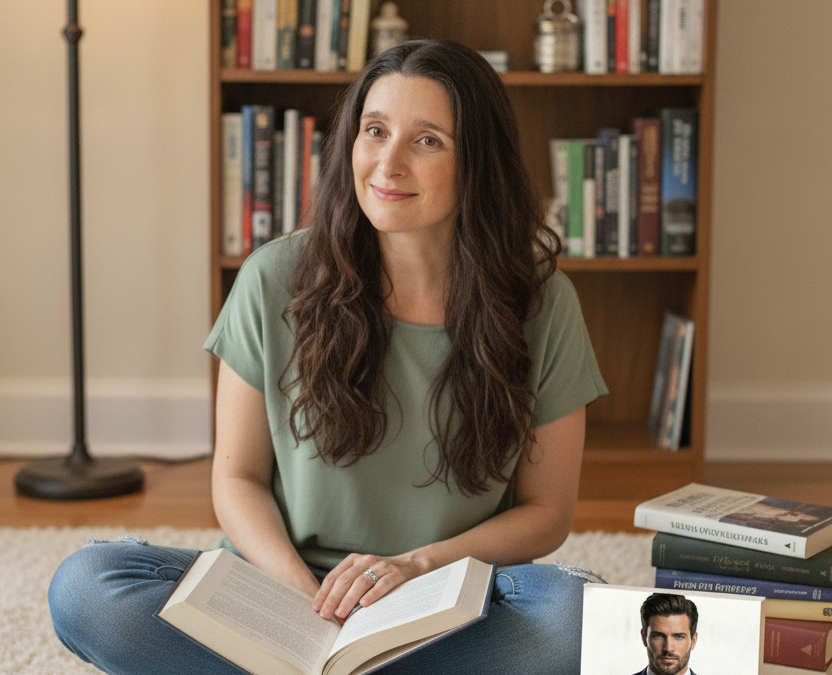
Why I Write Mythology Romance: My Real Story
Mythology romance has always lived at the intersection of the eternal and the deeply personal for me. If you have ever wondered how Victoria Pinder ended up writing myth-based love stories alongside Miami billionaires and displaced royals, I want to tell you the real answer — because it is not the one you might expect. It starts with a library, a thunderstorm, and a dog-eared copy of Edith Hamilton I found on my grandmother’s shelf when I was twelve years old. And it has never really stopped.
I am USA Today Bestselling Author Victoria Pinder, and I have been writing romance for over a decade across more than 100 novels. The mythology romance corner of my catalog is one of the most personal things I have ever built as a storyteller. If you want to explore that world, the best place to start is my mythology romance page, where you can see every book in that collection alongside all retailer buy options. But before you dive into the books, I want to tell you the story behind them — because understanding why I write mythology romance will change how you read it.

What Does Mythology Romance Mean to Victoria Pinder?
When people hear mythology romance, they often picture something dusty and academic. Swords. Togas. Characters with unpronounceable names who exist primarily as symbols. That is the furthest thing from what I write.
For me, mythology romance means taking the emotional core of an ancient story — the jealousy, the obsession, the forbidden love, the price of defying the gods — and asking what that would feel like for a real human being standing in the middle of it. Not a hero on a pedestal. A person. Someone who is terrified and confused and deeply in love and trying to figure out what they are willing to sacrifice for it.
The myths have always been about that. We just forgot to read them that way.
I grew up reading mythology the way some kids read fairy tales. Not as history. As emotional truth. Persephone was not just kidnapped by Hades. She was a young woman who found something in the underworld that the world above had never given her, and she chose to stay for half the year, and that choice broke her mother, and the whole earth went cold because of it. That is a romance. That is a deeply specific, deeply human story about what it costs to choose someone fully.
When I started writing Romancing Theseus and Romancing Antigone, I was not trying to write mythology romance as a genre exercise. I was trying to figure out what those characters would feel in their bodies, in their chests, in the 3 AM moments when they could not sleep. Available on Amazon, Apple Books, Barnes and Noble, Kobo, Google Play, and more through my website.
The Grandmother’s Bookshelf That Started Everything
I want to tell you about my grandmother’s bookshelf because I think it explains something important about why mythology romance pulls at me the way it does.
My grandmother was not a woman who talked about books. She was a woman who lived them. Her shelves were not organized. They were layered, the way a real reader’s shelves get layered — paperbacks stacked sideways on top of upright hardcovers, a coffee ring on the cover of something she clearly read more than once, a strip of torn notepaper marking a page she wanted to return to.
Edith Hamilton’s Mythology was on the third shelf, wedged between a Danielle Steel novel and what I think was a church directory from 1987. I pulled it out because the cover was interesting. I stayed up all night because Medea broke my heart.
Medea is not a romance heroine in the traditional sense. She is a woman who helped a man achieve everything and then watched him discard her, and her response was catastrophic and irreversible. The myth has no happy ending. But what I felt reading it at twelve years old was the recognizable shape of a love story gone terribly wrong — and the question underneath it that mythology romance keeps asking: what does a person do when the person they love most becomes the person who destroys them?
I did not have the vocabulary for it at twelve. But I have been trying to answer that question in my books ever since.
Why Mythology Romance Tropes Hit Different Than Other Romance Tropes
Here is something I believe deeply as a writer: mythology romance works in the romance genre specifically because the myths gave us the original versions of every trope we love.
Think about it this way. Forbidden love? Pyramus and Thisbe. Their families kept them apart and they communicated through a crack in a wall and it ended in tragedy, and Shakespeare literally rewrote it as Romeo and Juliet, and we are still writing versions of it today because the emotional wound is that old and that real.
Enemies to lovers? Eros and Psyche. She was sent to destroy him. She fell for him in the dark, literally, without ever seeing his face. When she finally looked, she lost him, and she had to complete a series of impossible tasks to win him back. If that is not an enemies-to-lovers slow burn with a guaranteed emotional gut punch, I do not know what is.
Forced proximity with a power imbalance? The entire Hades and Persephone myth. A man with more power than she could comprehend, a world she never asked to enter, and a gradual realization that she was not entirely a captive.
What mythology romance does is give these tropes their original emotional weight back. When I write a mythology-inspired hero, I am drawing on thousands of years of human beings trying to articulate what obsessive love feels like, what forbidden desire costs, what it means to be transformed by loving someone.
That is not a small thing. That is the whole archive of human longing, and I get to play in it.
The Specific Books: What I Was Thinking When I Wrote Them
I want to talk about the mythology romance books specifically because I think the behind-the-scenes context changes how you experience them as a reader.
Romancing Theseus
Theseus is a complicated hero in the original myths. He is the slayer of the Minotaur, yes. He is also the man who abandoned Ariadne on an island after she helped him survive the labyrinth. He forgot to change his sails and his father jumped off a cliff in grief and that is why the Aegean Sea has that name. He is, in short, a man who means well and causes enormous collateral damage.
I found that interesting. Not because I wanted to write an unlikeable hero, but because I wanted to write a man who has to reckon with the gap between who he believes himself to be and what his choices have actually cost the people around him. That felt deeply human to me. That felt like a story worth telling.
When I was writing Romancing Theseus, I was going through a period of thinking a lot about legacy. About what we inherit and what we choose. That runs through the House of Morgan series too — Peter Morgan spending twenty books refusing to become his father. The mythology romance books and the contemporary billionaire world I write are asking the same question in different costumes: who do you choose to be when the story you were handed says you should be something darker?
Romancing Theseus is available on Amazon, Apple Books, Barnes and Noble, Kobo, Google Play, and more. Find all retailer links at victoriapinder.com.
Romancing Antigone
Antigone is one of the most morally clear figures in all of Greek drama and one of the most tragic. She knows exactly what she believes is right. She knows exactly what it will cost her. She does it anyway. Sophocles wrote her as a character who chooses principle over survival, and it destroys her.
I was not willing to let that stand.
When I wrote Romancing Antigone, I wanted to give her the love story she never got in the original. I wanted to put a hero next to her who could match her moral clarity, who was not threatened by her certainty, who wanted to stand in the fire with her instead of watching from a safe distance. That kind of hero is hard to write. He has to be strong enough to deserve her and humble enough to follow her lead when she knows she is right.
I wrote that book at night, mostly. I remember my dog was asleep on my feet and I had this very specific playlist going that was all instrumental, no lyrics, because I needed to hear Antigone’s voice without any other words competing with it. Some books you write with your brain. That one I wrote with something closer to my chest.
Romancing Antigone is available on Amazon, Apple Books, Barnes and Noble, Kobo, Google Play, and more. Find all retailer links at victoriapinder.com.
How Mythology Romance Connects to the Rest of My Catalog
This might surprise you, but I think of my mythology romance books and my contemporary series as part of the same conversation. They are asking the same questions in different settings.
The House of Morgan saga is, at its root, a mythology. Mitch Morgan is a dark patriarch whose shadow stretches over everything and everyone he touched. His children are all trying to find their way out of his labyrinth. Peter Morgan spent twenty books being the Theseus who actually changes — who finds every lost branch of his family, who refuses to use power the way his father did, who chooses love over legacy. That is a mythological arc in a Miami penthouse.
The Favorite Series has the same bones. Jay Marshall is a man with enormous power trying to figure out what matters. The transactional arrangements that become real love. The found family built by choice rather than blood. Miami as a world where modern myths play out in board rooms and on film sets.
If you love mythology romance for its emotional scale, I genuinely believe you will love the Favorite Series too. The stakes feel the same to me as a writer. The question underneath every book is the same: what does a person sacrifice for love, and was it worth it?
You can explore the full Miami billionaire world at victoriapinder.com/contemporary-romance.
What Makes Mythology Romance Resonate With Readers in 2026?
I get asked this a lot and I think the honest answer is this: we are living in a moment where everything feels uncertain and mythologically scaled. Political upheaval. Families divided. Power structures that feel ancient and unyielding. The myths were written specifically for moments like this.
Mythology romance gives readers a container for big feelings. When Antigone defies a king to do what she believes is right, we recognize something in that. When Psyche completes the impossible tasks, we feel the determination of someone who refuses to let love be the thing they failed at. When Theseus finally reckons with the damage he has done, we see the possibility of a person actually changing.
These are not small stories. They are the biggest stories humans ever told about love. And romance readers, in my experience, are exactly the audience that understands why those stories matter.
If you are new to my mythology romance books, the mythology romance page on my website is the best place to start — every book listed, every retailer linked, the full picture of what I have built in that corner of my catalog.
A Table: Victoria Pinder Mythology Romance at a Glance
| Book Title | Myth Source | Core Trope | Where to Get It |
|---|---|---|---|
| Romancing Theseus | Greek — Theseus and the Minotaur | Redemption arc, forced reckoning | All retailers via victoriapinder.com |
| Romancing Antigone | Greek — Sophocles, Antigone | Forbidden love, moral courage, HEA rewrite | All retailers via victoriapinder.com |
Where to Start With Victoria Pinder Mythology Romance
If you are brand new to my mythology romance books, start with Romancing Theseus. It has the fullest emotional arc of the mythology romance titles and the hero is the kind of complicated, flawed, genuinely trying man that I love writing most.
If you love mythology romance with a heroine who does not bend, start with Romancing Antigone. Antigone will wreck you in the best possible way.
And if you want to explore the broader world of my romance catalog — contemporary billionaires, displaced royals, Scottish lairds, secret babies with pro athletes — the full series guide lives at victoriapinder.com/romance-book-series.
I have been writing stories about love for over a decade and published more than 100 novels across multiple series. Mythology romance is one of the places where I feel most like myself as a writer — where the emotional scale of what I am trying to say matches the emotional scale of the source material. I hope you feel that when you read these books. I hope Theseus surprises you. I hope Antigone makes you want to stand for something. That is the whole point.
DM me the word BOOKS on Instagram for my complete catalog, or visit victoriapinder.com to start exploring.
Frequently Asked Questions
What is mythology romance as a genre?
Mythology romance is a romance subgenre that draws on ancient myths — primarily Greek, Roman, Norse, or Celtic — as the source material or emotional framework for a modern love story. The books feature myth-inspired characters, settings, or plot structures reimagined with a guaranteed HEA. Victoria Pinder writes mythology romance that centers the emotional truth of the original myths while giving the characters the love stories the myths denied them.
Where should I start with Victoria Pinder mythology romance?
Start with Romancing Theseus for a full redemption arc with a complicated, layered hero. If you prefer a fierce, morally clear heroine, begin with Romancing Antigone. Both books are available on Amazon, Apple Books, Barnes and Noble, Kobo, and Google Play — find all retailer links at victoriapinder.com/mythology-romance/.
Are Victoria Pinder mythology romance books standalone or part of a series?
Victoria Pinder writes mythology romance books that can be read as standalones with complete HEA endings, though the mythological world and character connections reward readers who explore the full collection. Each book features a new central couple. No cliffhangers — every book closes the romance arc completely.
What tropes appear in Victoria Pinder mythology romance?
Victoria Pinder mythology romance features forbidden love, redemption arcs, forced reckoning, morally courageous heroines, impossible tasks as proof of devotion, and power imbalances that shift as the hero earns trust. The books draw on Greek drama’s emotional scale and reframe it with modern romantic sensibility and a happily-ever-after guarantee that the original myths did not offer.
How does mythology romance connect to Victoria Pinder’s other series?
Victoria Pinder writes mythology romance and contemporary billionaire romance as part of the same emotional conversation — both explore what people sacrifice for love, how legacy shapes identity, and whether a person can choose to be different from the story they inherited. Readers who love mythology romance often also love the House of Morgan saga and the Favorite Series for their similarly large emotional scale.
Is Victoria Pinder mythology romance appropriate for all romance readers?
Victoria Pinder writes sensual, emotionally intense romance — not explicit erotic romance. Her mythology romance books are deeply character-driven with high emotional stakes, romantic tension, and guaranteed HEA endings. They are appropriate for adult romance readers who love trope-rich storytelling with literary depth. Not reverse harem — every book features one central couple.
Where can I find all of Victoria Pinder mythology romance books?
The complete Victoria Pinder mythology romance collection is listed at victoriapinder.com/mythology-romance/ with buy links for all major retailers including Amazon, Apple Books, Barnes and Noble, Kobo, and Google Play. Victoria is a wide author — her books are never exclusive to a single retailer and are always available everywhere readers shop.
