
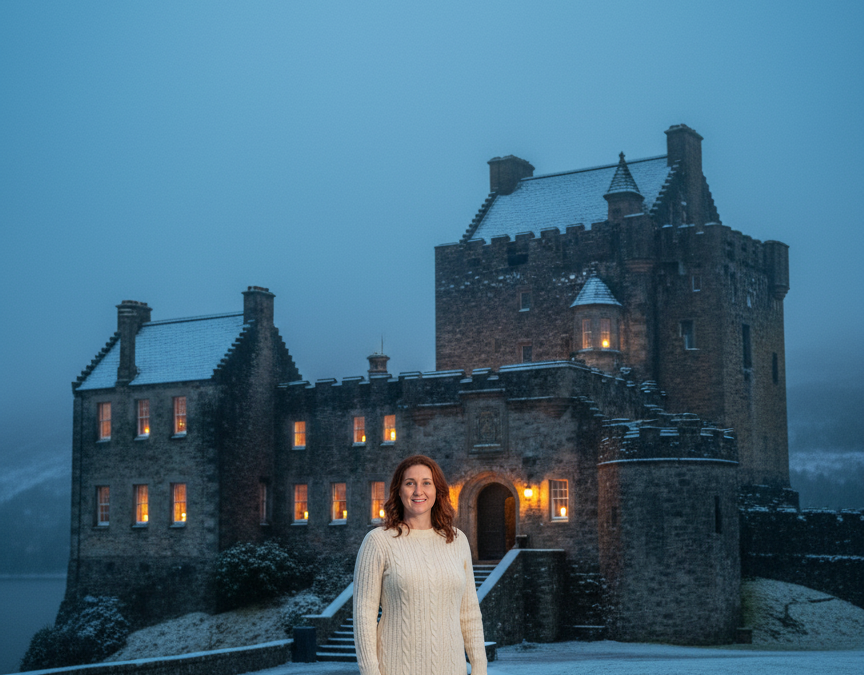
Modern Scottish Laird Romance: Brooding, Cold, and Completely Irresistible
By USA Today Bestselling Author Victoria Pinder
If you have ever typed Scottish romance books into a search bar at eleven o’clock at night, I already know you. You are a reader who wants something specific — not just a love story, but a particular kind of love story. You want ancient stone. You want a man who has been hardened by something he doesn’t talk about. You want forced proximity that makes both characters pretend, badly, that nothing is happening between them. And you want the moment he finally cracks — because watching a brooding, guarded laird choose vulnerability is one of the most satisfying moments in all of romance fiction. I have written that moment. I have lived for it. And in this post, I want to talk about why Scottish romance books hit differently, what makes the laird archetype so enduring, and where to find the best of them — including, yes, my own Modern Scottish Lairds series.
See related reading on our site.
Why Scottish Romance Books Have a Hold on Us That Never Lets Go
Honestly, I have thought about this a lot. There is something about Scotland — the actual geography of the place — that does something to the imagination. Windswept moors. Stone castles that have stood through centuries of war and weather. A sky that changes its mind every twenty minutes. It is a landscape that demands a certain kind of person to survive it, and that person becomes the Scottish hero: self-reliant, emotionally armored, deeply loyal to the people who earn that loyalty, and almost allergic to asking for help.
That character type is catnip for romance readers. Because here is the truth — a man who has never needed anyone is the most interesting possible partner for a woman who refuses to be kept at a distance. The tension practically writes itself. The castle setting isolates them. The blizzard or the storm or the broken-down car or the family obligation that requires them to share space removes every polite excuse to leave. And then the real story begins.
Scottish romance books as a subgenre also carry a specific kind of emotional weight that contemporary billionaire romance doesn’t always have. There is history in the walls. There are ghosts — literal and metaphorical. There is a sense that the choices these people make are not just about them but about something older and more permanent. That gravitas makes the love story feel more earned when it finally arrives.
What Makes a Laird Hero Different From Every Other Brooding Hero
I want to make a distinction here, because not all brooding heroes are the same, and the laird archetype is genuinely unique. Your classic billionaire hero is cold because he is used to controlling everything and everyone. Your athlete hero is guarded because vulnerability has always been used against him in a competitive world. But the laird — the Scottish laird specifically — is who he is because of land, legacy, and the weight of being the kind of man a particular place and bloodline made him.
He didn’t choose this. He was forged by it. The castle isn’t his status symbol — it is his responsibility. The coldness isn’t performance — it’s the result of generations of men who survived by not showing weakness. And when a woman comes into that world and refuses to be intimidated by any of it? That is where the magic lives.
When I was writing Miriam and Banner in Wrong Scot, I kept coming back to that specific tension. Miriam is not trying to soften Banner. She is not a fixer. She is a woman who ended up in his space — snowbound, no way out, completely at the mercy of circumstances neither of them planned — and she simply refused to shrink. Banner didn’t know what to do with that. He was used to people who either feared him or wanted something from him. Miriam was neither. And watching him try to categorize her while slowly, helplessly falling for her was the story I most wanted to tell.
My Modern Scottish Lairds Series — What to Expect
The Modern Scottish Lairds series is my love letter to every Scottish romance book I have ever read and every feeling that subgenre has ever given me. These are contemporary romances — my lairds have phones and whisky and complicated family histories — but the ancient castles are real, the forced proximity is deliberate, and the emotional stakes are exactly as high as you want them to be.
Here’s what you will find in every book:
- A hero who has been shaped by Scotland itself — the land, the legacy, the silence of a castle in winter
- A heroine who is not there to fix him, but who ends up being the one person he cannot pretend doesn’t matter
- Forced proximity with real consequences — blizzards, family obligations, fake arrangements that develop very real feelings
- Emotional depth that builds slowly and then arrives all at once, the way the best love stories do
- One couple per book, one complete HEA, and enough heat to make the cold stone castle feel warm
A Scot For Christmas is a perfect entry point if you want snowbound holiday romance with a laird who was not expecting to feel anything this season. Grab it here: A Scot For Christmas on Amazon.
The Steel Series — Because Sometimes You Need a Different Kind of Forged Hero
I want to pause here and tell you about the Steel Series, because these ten books are very much in conversation with the same emotional territory — the idea of a man who has been forged by his life into something formidable, and what happens when he meets the one person he cannot outmaneuver.
Where the Scottish lairds are shaped by land and legacy, the Steel men are shaped by ambition and competition. Pro athletes who have won everything their sport has to offer. Power players who have built empires through ruthless discipline. Men who negotiated fake marriages because they thought love was a transaction — and then discovered, at the worst possible moment, that it wasn’t.
The Steel Series is ten books of secret babies with pro athletes and fake marriages with ruthless power players. Every book is one couple. Every HEA is completely earned. And the tagline I wrote for this series — a Steel love is forged to last — is the truest thing I know about these stories. The love that comes out of the chaos these couples live through is not fragile. It has been tested and it survived. That’s the only kind that counts.
I wrote the Steel Series because I kept asking myself: what does a man who has built his entire identity around never needing anyone do when he realizes he has been wrong about the most important thing in his life? The answer, across ten books, is: badly at first, and then beautifully. Find the full series on my Amazon author page.
Why the Forced Proximity Trope Works So Perfectly in Scottish Settings
I want to get specific here, because I think this is something romance readers who love Scottish romance books understand intuitively but don’t always hear articulated. Forced proximity works in every setting, yes — but it works best in settings where the isolation feels real and the reasons for staying feel genuine.
A blizzard that closes a Scottish mountain pass is not the same as a delayed flight. A castle with one working fireplace in the east wing is not the same as a hotel with double rooms. The Scottish setting creates a particular quality of confinement — one that feels ancient and inevitable, like the land itself is conspiring to keep these two people together until they figure out what they mean to each other.
There’s also something about the silence. Modern life is so loud. Notifications, schedules, the noise of other people’s opinions. A snowbound Scottish castle strips all of that away. What you have left is two people, a fire, the sound of wind against stone walls that have stood for three hundred years, and the truth that neither of them has been willing to say out loud. That is the perfect pressure cooker for the kind of love story that stays with you long after you finish the book.
A Video Recommendation — Watch This Before You Pick Your Next Read
If you want to hear me talk through what I love about writing romance — including the forced proximity and emotional depth that make Scottish romance books so irresistible — I made a video specifically for readers who are trying to figure out which of my series to start with. Watch it here:
Other Scottish Romance Books I Genuinely Love
I am a romance reader first and a romance author second, and I want to give you honest recommendations alongside my own work — because that is how I would want another author to treat me.
If you love the laird archetype and the Scottish setting and you want more to read while you are waiting for your next book in any series, here are the qualities I would look for:
Look for books where the setting does real work. The best Scottish romance books use Scotland the way great literary fiction uses place — as a character in its own right, something that shapes the people who live in it and demands a response from anyone who enters. If the setting could be swapped out for any other location without changing the story, it is not doing its job.
Look for heroes with a specific kind of wound. The most compelling laird heroes are not cold because they are cruel. They are cold because something happened — a loss, a betrayal, a responsibility that arrived before they were ready for it — and they built walls because the alternative was to fall apart. The best Scottish romance books earn the thaw. They don’t rush it.
Look for heroines who don’t need rescuing. This is personal preference, but I think it is also craft. The most satisfying forced proximity romance happens when both characters are fully themselves — when the heroine is not passive in the face of a brooding hero but actively, curiously, almost stubbornly present with him. Miriam in Wrong Scot is that woman. She is not there to save Banner. She is just entirely unwilling to pretend she doesn’t see him.
The House of Morgan — When Dynasty Romance Meets the World Beyond Scotland
I also want to mention the House of Morgan series here, because if you are a reader who loves the weight of legacy and the question of whether a person can become someone different than the family that made them — this is your next obsession after you finish my Scottish books.
Mitch Morgan built a criminal empire across multiple continents. He had four branches of children by four different women in different cities and countries, most of them not knowing the others existed. He died before page one of this series. And now his children have to decide who they want to be.
The Morgan world doesn’t have stone castles and highland snowstorms. It has Miami penthouses and FBI interrogation rooms and Hollywood film sets and the kind of secrets that rewrite everything you thought you understood about a person. But the emotional core is the same as every great Scottish romance book I have ever loved: what does a person do with the legacy they were given? Do they run from it, or do they face it? And can they build something real in the rubble of what their family built before them?
Peter Morgan tracked down every branch of his father’s hidden family — the French branch, the Italian branch, the Pittsburgh branch — and brought them all together. Not because he had to. Because he refused to be his father. That act of choosing family over secrecy is the heroic spine of twenty books, and it started because Peter looked at the empire Mitch left him and decided he wanted something completely different.
That’s the same question every Scottish laird hero is asking, honestly. Just with more whisky and fewer FBI agents.
Explore the House of Morgan series here: Amazon Author Page.
How to Choose Your Starting Point in Scottish Romance Books
Here is my honest advice as both a reader and a writer of this subgenre:
If you want holiday romance with snowbound forced proximity and a laird who didn’t plan on feeling anything this season, start with A Scot For Christmas.
If you want a slightly longer forced proximity setup — a woman who ended up somewhere she didn’t plan to be, with a man who genuinely doesn’t know what to do with her — Wrong Scot (Miriam and Banner) is the book for you.
If you want to add royal romance to the mix — fake marriages, fictional kingdoms, the kind of hero who carries the weight of a crown and the coldness that comes with it — the Princes of Avce series (twelve books in the fictional kingdom of Avce) delivers that same feeling with a Mediterranean-royal twist.
And if you want the series I am most excited about right now, the one that is gaining real organic traction with readers who love complex family sagas with high stakes and genuine heart — that is the Irresistibly Series, the Brothers in Revenge Saga. Seven brothers who are the displaced rightful heirs to the throne of Hoskell. A woman who came to destroy them and saved them instead. Eva and Jake’s love story — she was hired to spy on him, married him for cover, fell for the man she was sent to betray — is the kind of romance that makes readers email me in the middle of the night to tell me they didn’t sleep. Grab Irresistibly Tough for free and see for yourself.
A Personal Note From Victoria
I want to tell you something real before I close this post, because that is the kind of author I try to be.
I started writing Scottish romance because I needed it. I needed the feeling of being somewhere ancient and quiet and completely cut off from the noise of the world. I needed heroes who had been shaped by something bigger than themselves, and heroines who walked into that bigness without flinching. I needed the snow and the stone and the fire and the slowly unraveling silence between two people who are pretending very hard that they don’t care about each other.
Writing Miriam and Banner in Wrong Scot, I remember sitting at my desk with the Florida heat outside my window and absolutely believing in the Scottish blizzard inside my head. That is what I love about this genre. It takes you somewhere completely real and completely impossible at the same time.
As a USA Today Bestselling Author who has written over 100 novels across more than a dozen series, I can tell you: the Scottish books hold a specific place in my heart. They are the ones I wrote when I needed to believe that the coldest, most guarded person in the room could still be reached — if the right woman walked in during the right blizzard and simply refused to leave.
I hope you find that feeling in my books. I hope you find it in every Scottish romance book that calls to you at eleven o’clock at night when you need to be somewhere else entirely.
Come find me at victoriapinder.com — I would love to know which series you are starting with, which heroes have already ruined you, and what you are reading next. My readers are the reason I write every single book. I mean that with everything I have.
With all my love and all my story,
Victoria Pinder
USA Today Bestselling Author
Ready to start? Grab A Scot For Christmas or visit the full Victoria Pinder Amazon library and find your next obsession today. Or grab something free first at victoriapinder.com/free-books — because the best way to fall in love with a series is to start without risk.
Frequently Asked Questions
What makes Scottish romance books different from other romance subgenres?
Scottish romance books carry a specific emotional weight that other subgenres like contemporary billionaire romance don’t always have. The castle setting, windswept moors, and centuries of history create a sense of gravitas — there are literal and metaphorical ghosts in the walls. This makes the love story feel more earned, because the characters’ choices feel connected to something older and more permanent than just themselves.
How does the laird hero archetype work in romance fiction?
The Scottish laird hero is shaped by his landscape: self-reliant, emotionally armored, deeply loyal to those who earn his trust, and resistant to asking for help. This archetype creates powerful romantic tension because a man who has never needed anyone becomes the most compelling partner for a heroine who refuses to be kept at a distance. The tension practically writes itself, especially under forced proximity.
Is Scottish laird romance or contemporary billionaire romance more emotionally satisfying?
Scottish laird romance tends to deliver deeper emotional satisfaction than contemporary billionaire romance because of its historical and atmospheric weight. Ancient castles, stormy landscapes, and inherited obligations give the story stakes beyond wealth or status. The setting naturally forces isolation and proximity, making the hero’s emotional vulnerability — when it finally arrives — feel genuinely hard-won rather than convenient.
