
Scottish Romance Books: The Tropes That Actually Hook You
If you have ever picked up a Scottish romance book and finished it in one sitting, you already know something that took me years to figure out as a writer: it is not really about the accent. Scottish romance books hook readers because they combine the most powerful romance tropes — forced proximity, brooding heroes, and high emotional stakes — inside a setting that makes all of them feel inevitable. The castle is not decoration. The blizzard is not a plot device. They are the mechanism that makes the magic happen.
I am USA Today Bestselling Author Victoria Pinder, and I have published over 100 novels across multiple series. When I started writing Scottish romance books, I thought I was writing about location. What I discovered is that I was actually writing about isolation, about what happens when two people cannot escape each other and eventually stop wanting to. That distinction changes everything about how you build a story.

This post is not a general overview of Highland romance history — I have already covered the broad strokes of the subgenre and my own series elsewhere. What I want to do here is go deeper: break down the specific tropes inside Scottish romance that make readers finish a book and immediately look for the next one, explain why those tropes work differently in a Scottish setting than anywhere else, and help you figure out which type of Scottish romance is actually the right fit for your reading taste right now.
What Tropes Appear Most Often in Scottish Romance Books?
Scottish romance is not a monolith. Readers searching for Scottish romance books in 2026 are actually searching for several very different emotional experiences, and the trope underneath the setting is what determines whether a book lands for you personally. Here are the tropes that appear most reliably in the subgenre and why each one works.
Forced Proximity and the Snowbound Castle
This is the foundational trope of Highland romance and it earns that status. The logic is airtight: a Scottish castle in winter is geographically isolated, architecturally inescapable, and emotionally charged in a way that a modern apartment or a city hotel simply cannot replicate. When a blizzard traps two people in a structure that has been standing for five hundred years, the weight of that setting presses down on both of them. There is nowhere to go. There is no scrolling your phone to avoid a conversation. The intimacy is forced and then it becomes chosen.
What makes forced proximity land in Scottish romance specifically is the class dimension. In many Highland romances, one character belongs to that castle and one does not. The laird knows every corridor and every draft. The heroine is reading the building like a stranger. That power imbalance creates tension that goes far beyond a standard trapped-together setup.
Grumpy Hero, Sunshine Heroine
The brooding Scottish laird is a romance archetype for a reason that goes deeper than aesthetics. A man who has inherited a crumbling estate, a complicated family history, and the pressure of an entire community’s livelihood does not have the luxury of being cheerful. His gruffness is earned. His walls are load-bearing. When a warm, optimistic heroine walks into that world and refuses to treat his coldness as permanent, the emotional arc carries real weight because both positions are completely understandable.
The grumpy-sunshine dynamic hits differently in Scottish romance because the setting validates the hero’s darkness. He is not moody for no reason. He is carrying something ancient and heavy. The heroine’s light is not naive — it is brave. That reframe is what makes readers root for both of them instead of just waiting for the hero to soften.
Second Chance Romance in a Highland Setting
Second chance romance works in Scottish settings because the past feels permanent there. When two people who loved each other years ago meet again at a Highland estate or a family gathering in Scotland, the setting itself becomes a repository of memory. Every room has a history. Every landscape is a reminder. The emotional archaeology of a second chance story is amplified by an environment that does not let anything be forgotten easily.
How Is Scottish Romance Different From Other Historical or Contemporary Subgenres?
This is a question I get from readers all the time, especially readers who are deciding whether to try Scottish romance for the first time or who bounced off one Scottish romance and are not sure if the whole subgenre is not for them. The answer matters because Scottish romance sits at an interesting intersection.
Unlike pure historical romance, modern Scottish romance (and most of what is selling well on BookTok right now) is set in the present day. The laird drives a truck. He has a mobile phone. He is dealing with a leaking roof and a heritage property that costs more to maintain than it generates. That contemporary grounding makes the fantasy feel accessible in a way that full historical romance does not always achieve for newer readers.
Unlike contemporary romance set in generic cities or beach towns, Scottish romance has a landscape that actively participates in the story. The moors, the snow, the stone walls, the physical remoteness — these are not backdrop. They are plot. A reader who loved a beach romance for its warm community vibes and found it comfortable and sunny will find Scottish romance emotionally colder and more pressurized. That is a feature, not a bug, for the right reader.
Which Type of Scottish Romance Book Should You Start With?
Here is a practical breakdown by reader preference. I have formatted this as a comparison because the honest answer is that not every Scottish romance is the same experience, and starting with the wrong type for your taste is the main reason readers sometimes bounce off the subgenre.
| If You Love… | You Want This Type | Core Tropes |
|---|---|---|
| Cozy, warm community feel | Contemporary Scottish small town | Found family, second chance, single parent |
| Tension, pressure, no escape | Snowbound castle / forced proximity | Grumpy hero, stranded, one fireplace |
| Unfinished emotional business | Second chance Highland romance | Reunion, old wounds, new stakes |
| Obligation meets attraction | Arranged marriage or wedding-adjacent | Fake engagement, family duty, slow burn |
| Alpha hero with real softness | Billionaire laird contemporary | Wealth, protective instinct, walls coming down |
The five types above represent the main reader experience buckets inside Scottish romance. Most books blend two or three of these, which is why the subgenre rewards binge reading — once you find the specific blend that works for you, you want more of it immediately.
What Makes a Scottish Hero Different From Other Romance Heroes?
I want to be honest with you about this because I think it is the question that sits underneath most Scottish romance searches and never quite gets answered directly.
The Scottish laird archetype works because he carries institutional weight. He did not become powerful through ambition alone — he inherited something, and everything that came with it. The estate. The staff. The community that depends on whether the harvest was good or whether the roof needs replacing again. That weight creates a specific kind of emotional guardedness that is different from, say, a billionaire CEO who built his empire from scratch. The CEO chose his walls. The laird was born inside them.
When a heroine breaks through that guardedness, it means something different than it does in other hero archetypes. She is not just getting through to a man who chose to be closed off. She is reaching someone who has never known how to be anything else. That distinction is what makes readers feel the emotional payoff so sharply when it finally comes.
The Role of Heritage and Legacy in Scottish Romance
One thing that contemporary romance set in cities rarely has access to is generational weight. When your hero is the fourth generation to own a particular piece of land, every conversation about the future is also a conversation about the past. Scottish romance uses this constantly. The laird is not just choosing this woman — he is choosing what kind of man he wants to be in a lineage of men who made different choices. That adds a dimension to the romance that purely contemporary settings cannot easily replicate.
I think about this when I write my own Scottish romance books. The landscape is not just pretty. It is a character. It has opinions about what happens on it. And the hero who has spent his whole life reading that landscape is going to interpret the heroine through it, which means the setting shapes how he sees her from the very first page.
Victoria Pinder’s Scottish Romance Books: What Makes Them Different
My Scottish romance books live in what I call the Modern Scottish Lairds world, and the thing that sets them apart from a lot of Highland romance is that I lean hard into the contemporary grounding while keeping the atmospheric pressure fully intact. These are not men in kilts at a Renaissance fair. They are men dealing with leaking castle roofs, complicated family finances, and the very modern problem of falling for someone they absolutely should not fall for.
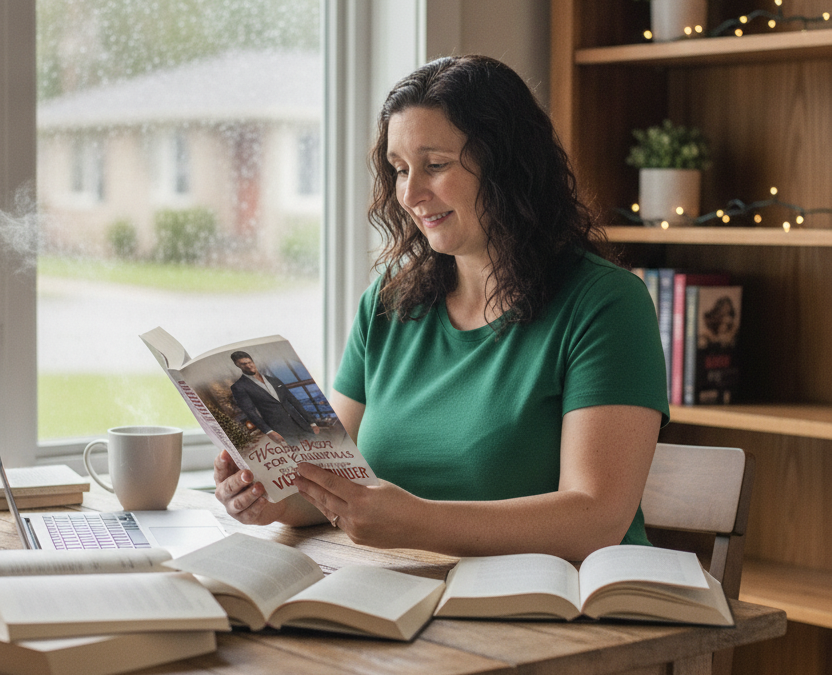
Wrong Scot for Christmas is the book I point readers to first because the forced proximity setup is so clean and the emotional tension escalates so naturally. Miriam and Banner are not supposed to be stranded together. The blizzard does not care about that. What I love about writing Banner is that his gruffness is not a performance — he genuinely does not know what to do with a woman who refuses to treat his closed-off energy as a final answer. Miriam’s warmth is not naive. It is a choice she makes every single day in that castle. That dynamic is the engine of the whole book.
Scottish Wedding Date takes the forced proximity into a wedding-weekend setting, which adds a layer of social obligation on top of the emotional pressure. Two people who do not want to be stuck together, at an event that is entirely about love and commitment, surrounded by people who are reading into every interaction. The setting doing triple duty — atmospheric, social, thematic — is something that Scottish romance uniquely enables.
For readers who want the second chance dimension, Scottish Second Chance is where I explored what it costs to walk away from someone in a setting that does not allow emotional distance. The landscape remembers. The hero remembers. And the heroine has to decide whether the love that was real enough to last through years of separation is also strong enough to survive what actually broke them apart.
All of my Scottish romance books are available on Apple Books, Amazon, Barnes and Noble, Kobo, Google Play, and more. You can find the full series at the Scottish romance hub on my website, which also has the complete reading guide.
I also want to mention the A Scot for Christmas standalone, which leans into the holiday forced proximity angle and is perfect for readers who want the full atmospheric Scottish experience with a guaranteed seasonal warmth underneath the tension.
A Personal Note on Writing in Scotland
I want to tell you something about why I write these books that I do not share very often. I am a Miami girl. I grew up with heat and humidity and noise and the Atlantic just there whenever you needed it. Scotland is the opposite of everything I grew up in. And I think that is exactly why I needed to write it.
There is something about a landscape that forces quiet that changes how people talk to each other. When I was building the world of my Scottish lairds, I kept coming back to this idea: what do you say to someone when there is nowhere else to look? When the snow has closed every road and the fire is the only warm thing in a five-hundred-year-old house, you either stay quiet or you finally say the real thing. My characters always end up saying the real thing. That is a choice I make as a writer. But I think it is also what the setting demands.
Are Scottish Romance Books Part of a Series or Standalones?
This is one of the most common questions I see from readers discovering the subgenre, and it is a genuinely useful practical question. Scottish romance books exist in both formats, and knowing which you are picking up changes your experience significantly.
My Modern Scottish Lairds books are interconnected standalones. Each book is a complete love story — you get a full HEA, no cliffhangers, no waiting for resolution. But the characters appear in each other’s lives in ways that reward reading the whole series. If you read Wrong Scot for Christmas first and then pick up Scottish Wedding Date, you will recognize faces and understand relationships at a depth that new-to-the-series readers will not have yet. That layering is intentional.
For readers who love the interconnected standalone format — where you can start anywhere but feel the richness of a full world when you read them in order — this is a format I use across multiple series. The search query interconnected standalone romance series is one of the most common ways readers find my books, and for good reason. It is exactly the reading experience I build toward.
If you want to explore that format beyond Scottish romance, the complete series guide on my website breaks down every series I have written and how each one is structured, so you can find your ideal entry point.
Scottish Romance Reading Order: Where to Start in 2026
If you are brand new to Scottish romance and want a specific starting point, here is my honest recommendation by reader type.
The 4 best entry points into Scottish romance books in 2026, based on what I see readers responding to:
- For forced proximity fans: Start with Wrong Scot for Christmas — the blizzard, the castle, Banner and Miriam. Clean setup, maximum tension, deeply satisfying payoff. Available on Apple Books, Amazon, Barnes and Noble, Kobo, Google Play, and more.
- For wedding chaos fans: Start with Scottish Wedding Date — forced proximity with a social pressure cooker layered on top. Available on all retailers.
- For second chance readers: Start with Scottish Second Chance — the history between these two characters hits harder because of the setting. Available on all retailers.
- For holiday romance lovers: Start with A Scot for Christmas — all the atmosphere, wrapped in seasonal warmth. Available on all retailers.
Every one of these books is a standalone, which means you can start anywhere on this list and have a complete, satisfying reading experience. The interconnected world rewards reading more, but never punishes you for reading less.
If you want the full picture — every book, every series, every reading order across my over 100 novels — DM me the word LAIRDS and I will send you the complete Highland romance reading guide. Or head directly to the Scottish romance series page to see everything in one place.
Frequently Asked Questions
What tropes appear most often in Scottish romance books?
Scottish romance books most commonly feature forced proximity in a castle or remote Highland setting, grumpy hero and sunshine heroine dynamics, second chance romance, and snowbound or weather-trapped scenarios. The setting amplifies all of these tropes because the landscape creates genuine emotional and physical isolation, making the intimacy between characters feel both inevitable and earned in a way that urban settings cannot replicate.
Do Scottish romance books need to be read in order?
Most modern Scottish romance series, including Victoria Pinder’s Modern Scottish Lairds books, are structured as interconnected standalones. Each book delivers a complete love story with a full HEA and no cliffhangers. You can start anywhere and have a satisfying experience. Reading in series order adds depth because recurring characters appear across books, but it is never a requirement for enjoying any individual story.
What is the difference between Scottish Highland romance and historical romance?
Scottish Highland romance today is predominantly set in the contemporary era — modern lairds with mobile phones, real estate pressures, and current-day problems — while historical romance is set in a specific past period with period-accurate language and social structures. Contemporary Highland romance keeps the atmospheric setting and brooding hero archetype while making the stories accessible to readers who prefer a modern emotional lens.
Are there Scottish romance books with billionaire heroes?
Yes. Many modern Scottish romance books blend the laird archetype with billionaire hero traits — inherited wealth, estate management, and significant financial power alongside the atmospheric Highland setting. Victoria Pinder’s Scottish romance books combine these elements, giving readers the emotional weight of legacy and heritage alongside the tension of a powerful, guarded hero meeting a woman he cannot dismiss.
Where can I find Scottish romance books by Victoria Pinder?
Victoria Pinder’s Scottish romance books — including Wrong Scot for Christmas, Scottish Wedding Date, Scottish Second Chance, and A Scot for Christmas — are available wide on all major retailers: Apple Books, Amazon, Barnes and Noble, Kobo, Google Play, and more. The complete series guide with reading order and buy links for every retailer is at victoriapinder.com/scottish-highland-romance/.
